
The PSA Maturity Model: Which of These 5 Stages Is Your Organization At?
A practical framework for understanding where your organization is on its PSA journey and what the next level looks like.
After eleven years of working with professional services organizations on their Professional Service Automation (PSA) implementations and optimizations, and over twenty years in the Professional Services space, I have seen a lot. I have walked into brand new implementations with incredible momentum and into systems that have been live for three years but are running at about 40% of their potential. I have worked with teams who are energized and ready, and teams who are exhausted and skeptical.
What I have come to understand is that every organization is on a journey. And most of them do not have a clear picture of where they actually are on that journey, or what the next step looks like.
So let me give you one.
I call this the SOMM: the Services Operations Maturity Model. It is not theoretical. It is what I have seen, repeatedly, across many years of PSA implementations. Whether you are a SuiteProjects Pro user, on another PSA platform, or still evaluating your options, the pattern holds. Five levels, real descriptions, no sugarcoating. Read through and ask yourself honestly: where does your organization land?
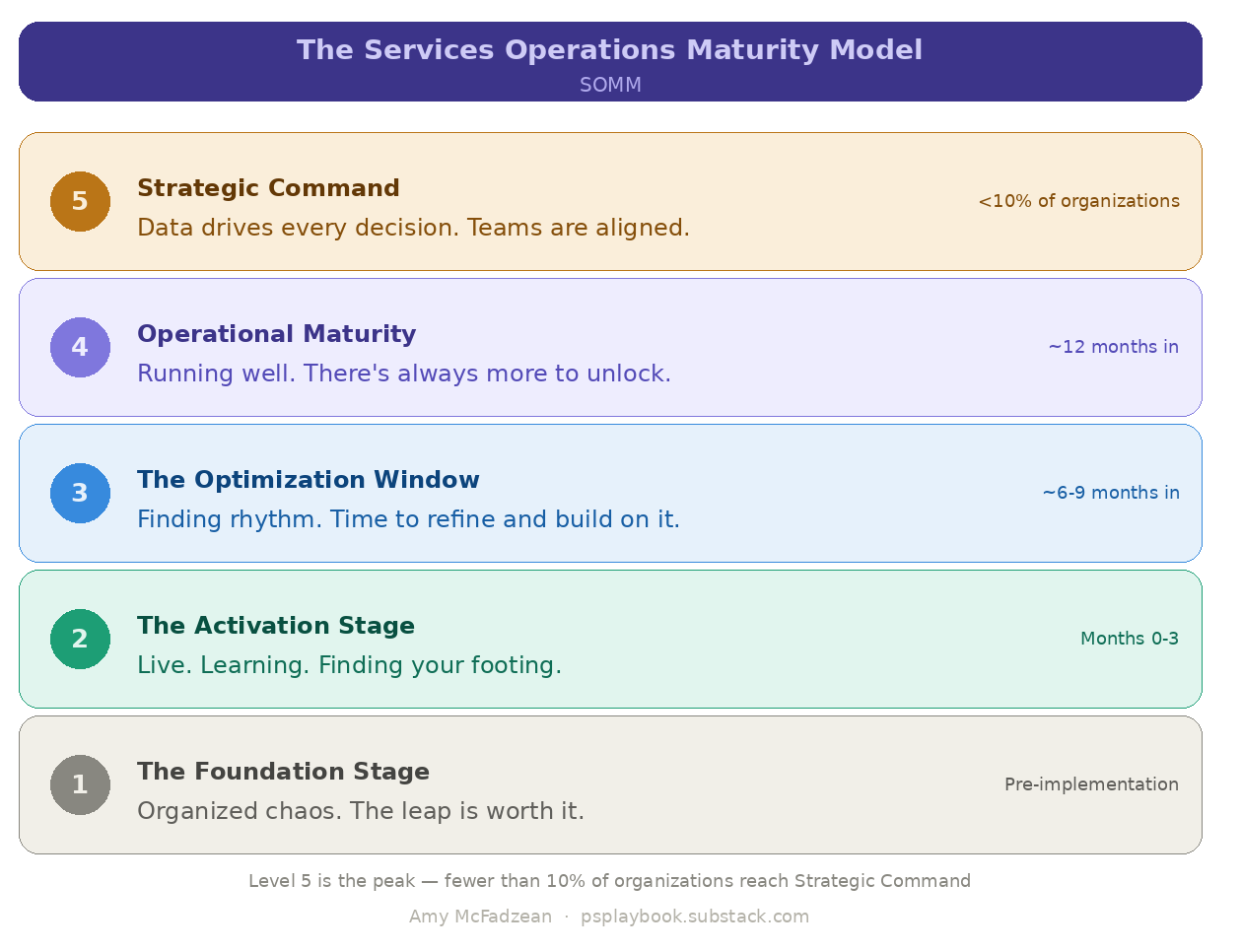
SOMM Level 1: The Foundation Stage
You are on Excel. Maybe Smartsheets. Maybe a combination of tools that have been duct-taped together over time because each one solved a specific problem in the moment. They got the job done, and there is no shame in that. These tools served a purpose.
But here is what they cannot do: they cannot scale with you. They do not promote real-time collaboration or visibility. They require significant manual effort to maintain, and that manual effort is sitting on the shoulders of real people who have other jobs to do.
The telling sign of Level 1 is not always that things are falling apart. Sometimes organizations here are functioning reasonably well, on the surface. What is underneath, though, is inefficiency that has become invisible because it has been normalized. You may or may not realize yet that something needs to change. But if you are reading this, you probably do. And that awareness? That is the first step.
If you are about to begin an implementation, it is worth knowing the most common reasons these projects go sideways before you sign anything.
SOMM Level 2: The Activation Stage (0 to 3 Months Post Go-Live)
You did it. You made the leap, got through implementation, and went live. That is genuinely a big deal, and it should be recognized as such.
Now comes the part nobody puts in the brochure.
You are adjusting. Your team is learning new processes. Timesheets may not be coming in consistently. The data is there but you are not entirely sure you trust it yet, or even what to do with it. You are probably running some light reporting but you have not yet found your rhythm or your cadence.
This is normal. This is expected. And this is exactly where a lot of organizations get discouraged, because the system is live but it does not yet feel like the promised land.
The most important thing at Level 2 is not perfection. It is consistency. Keep going.
SOMM Level 3: The Optimization Window (Approx. 6-9 Months In)
Something starts to shift around the six-month mark. You are beginning to understand the data. You are finding your rhythm. And, crucially, you are starting to identify things you want to do differently.
This is when the change request list comes to life. The little tweaks. The “now that we have been using this for a while, I wish we had set this up differently” moments. That list is not a sign that the implementation failed. It is a sign that your organization is maturing. You have lived in the system long enough to know what works and what does not.
Level 3 is also a great time to revisit functionality that got deprioritized during Phase 1, the things that were on the wish list but got pushed to “later.” Later is now.
And here is something I tell every client at this stage: this is an ideal window for an optimization engagement. You are not so new that you are still finding your footing, but you are not so entrenched in your processes that change feels threatening. The window is open. Use it.
SOMM Level 4: Operational Maturity (Around 12 Months In)
You are reporting. You are running. You have processes in place and your team is using the system. Things are working.
And yet.
This is the level I walk into most often when organizations call me for help. They are operational. They are surviving, and in many cases thriving. But there is a version of the phrase “I don’t know what I don’t know” that lives permanently at Level 4.
What does that look like in practice? It often means features or functionality that have gone unused, either because they were not needed at go-live, or because they are newer additions to the platform, or because the original configuration made sense at the time but the organization has evolved and the setup has not kept pace with it.
I have seen organizations live for two or three years in a configuration that made perfect sense on day one but was quietly limiting them by year two. They did not know there was a better way because nobody had shown them one.
This is not a failure. It is an invitation. It is exactly why optimization is not a one-time event.
SOMM Level 5: Strategic Command
Let me be honest with you: this level is rare. In my experience, fewer than 10% of the organizations I have worked with are truly here. And it is not because it is unachievable. It is because getting here requires sustained investment in three things simultaneously: people, processes, and technology.
A Level 5 organization is not just using their PSA. They are using it strategically. Their team is consistently capturing data, not because they are forced to, but because they understand why it matters. Leadership has clearly defined key metrics and the reporting is built around those metrics. Nobody is running reports for the sake of running reports. Every dashboard, every KPI, every piece of data has a decision attached to it.
And internally? They communicate. Across departments. Finance and Services and Operations are not working in silos. They are aligned.
It is not a fantasy. I have seen it. What made those organizations different was simple: leadership was bought in, not just at the start, but consistently. They carved out the time. They did the internal work. They invested in getting it right rather than just getting it done.
So Where Do You Fall on the SOMM?
Most organizations reading this will land somewhere between Level 2 and Level 4. That is not a criticism. That is the reality of running a services business while simultaneously trying to evolve the systems and processes that support it. It is a lot to hold at once.
If you are at Level 1, just starting to consider making the leap: trust the process. If you have a good, experienced consultant beside you, they are genuinely invested in your success. Their job is not just to configure software. It is to empower you to own it, understand it, and get real value from it. The overwhelm is real, and it is temporary.
If you are at Level 3 or 4 and something in this resonated: that feeling is information. The “huh, maybe there is more here than I am getting” instinct is almost always right.
There is always room to improve. I have built a career on believing that, and I have seen it proven right more times than I can count.
Where do you fall on the SOMM? I would love to hear from you in the comments. And, if you are not sure, that might be the most telling answer of all.
Amy McFadzean is a PSA consultant and SuiteProjects Pro specialist with 20 years in professional services and 11 years helping organizations implement, optimize, and get real results from their PSA platforms. PS Playbook is where she shares what she has learned along the way.
If this resonated, subscribe for more practitioner-first perspectives on PSA, professional services operations, and making your systems actually work for you.